

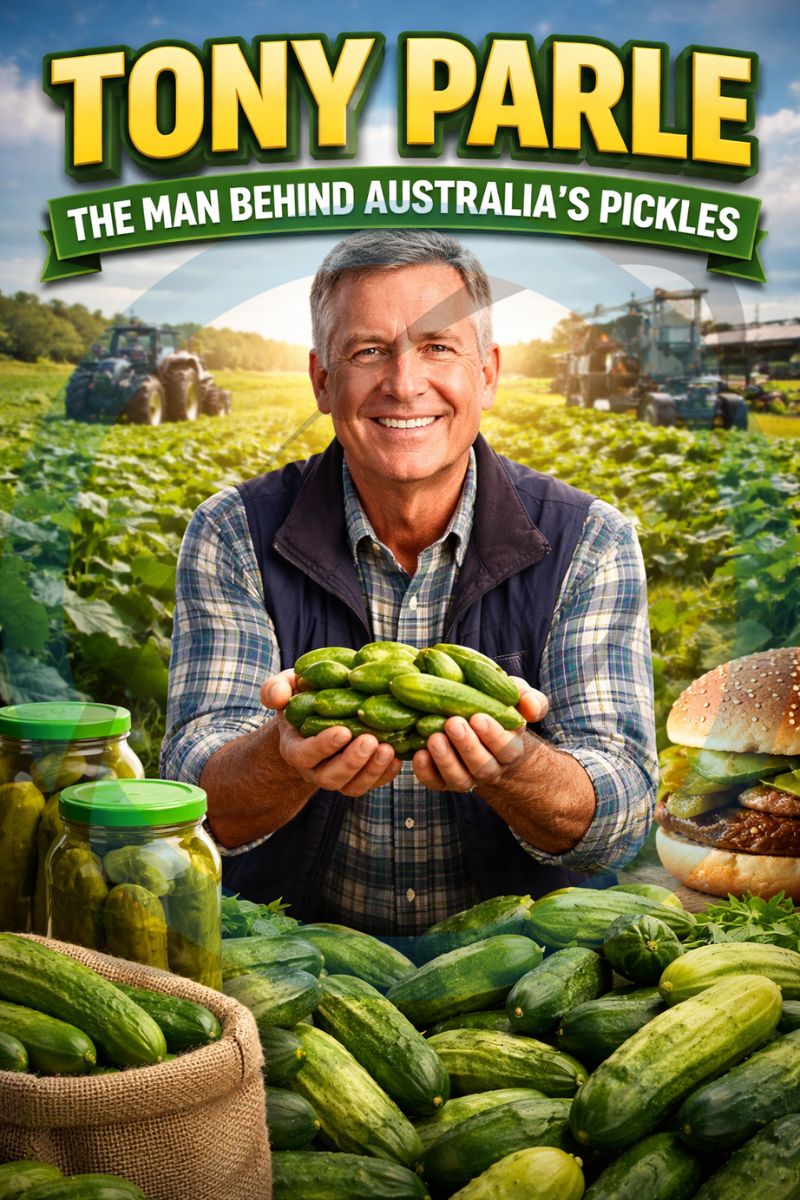
Tony Parle built one of Australia’s most unusual agribusiness success stories by mastering a single, overlooked ingredient: pickles. Operating far from consumer branding and public attention, Parle created a vertically integrated system capable of supplying McDonald’s Australia with uniform, high-volume pickles year after year.
His rise, collapse, and recovery reflect the realities of industrial farming at scale. This article examines how Tony Parle established dominance in gherkin production, why his operations became critical to McDonald’s, how financial overreach reshaped his business, and what his legacy reveals about modern agricultural entrepreneurship.
Tony Parle’s Entry into Industrial Agriculture
Tony Parle began as a farmer in Griffith, New South Wales, a region shaped by irrigation-driven agriculture. Unlike growers focused on open-market crops, Parle concentrated on contract farming, where precision, timing, and consistency matter more than yield alone.
Gherkins proved ideal for this approach. They require controlled harvesting windows, uniform sizing, and rapid processing. Parle recognized that few Australian producers were equipped to meet these demands at scale. By specializing early, he positioned his operation as a problem-solver rather than a commodity supplier.
This strategic focus laid the groundwork for what would later become synonymous with Tony Parle pickles.
Supplying McDonald’s: Precision Over Volume
Why McDonald’s Needed a Specialist
McDonald’s sourcing standards are unforgiving. Ingredients must remain identical across locations, batches, and seasons. For pickles, this means consistent crunch, acidity, thickness, and shelf stability.
Tony Parle built his production model around these constraints. His facilities handled growing, fermenting, slicing, and packing under one coordinated system. This reduced variability and allowed rapid corrective action when conditions changed.
As a result, Parle Foods became McDonald’s primary domestic pickle supplier, embedding Tony Parle deep inside one of the world’s most disciplined food supply chains.
Operational Discipline
Parle’s success rested on operational rigor:
- Harvesting schedules aligned to millimeter-level size requirements
- Controlled fermentation using brine tanks calibrated for uniform acidity
- Processing lines designed for food-service specifications rather than retail packaging
This infrastructure made Tony Parle pickles dependable rather than distinctive, which is exactly what large fast-food chains require.
The Industrial Reality Behind Tony Parle Pickles
Unlike retail pickle brands, Tony Parle’s products were never intended to express identity or flavor variation. Their purpose was performance.
Gherkins were harvested rapidly, often within narrow multi-day windows, to prevent oversizing. Fermentation followed immediately, locking in texture and flavor stability. Slicing and packing occurred under strict quality control to meet international food-safety benchmarks.
This approach allowed Tony Parle to supply enormous volumes without sacrificing uniformity. It also explains why Tony Parle pickles for sale are rarely found in consumer markets.
Expansion, Debt, and Structural Failure
Growth Beyond Margin
As contracts expanded, Parle Foods invested heavily in new facilities and infrastructure. While demand remained strong, the business became increasingly exposed to financial risk. Agriculture leaves little room for error, and external pressures—weather variability, financing costs, and operational debt—converged.
Eventually, Parle Foods entered receivership. Media coverage framed the event as a dramatic collapse, but the underlying issue was structural rather than operational. The system worked; the financial model did not.
Consequences of Single-Client Dependence
Relying heavily on one major buyer amplified vulnerability. Although McDonald’s demand remained stable, expansion costs outpaced cash flow flexibility. The episode highlighted a core lesson in contract agriculture: scale magnifies both efficiency and risk.
Recovery and Continued Industry Influence
Following receivership, assets were reorganized and operations continued under revised ownership. While Tony Parle’s public role diminished, his production methods and expertise remained embedded in the system.
Within agribusiness circles, Parle’s reputation endured. His experience became a reference point for growers exploring vertical integration, food-service contracts, and industrial processing.
Even after financial restructuring, Tony Parle pickles remained a benchmark for reliability rather than branding.
Tony Parle Pickles for Sale: What That Really Means
Despite frequent assumptions, Tony Parle pickles for sale does not refer to a consumer product line. His operations were structured for bulk, contract-based supply to food manufacturers and service chains.
This means:
- No branded retail distribution
- No direct consumer purchasing channels
- Production volumes tailored to long-term contracts
Businesses seeking industrial pickle supply often study Parle’s model, but casual buyers will not encounter his products on supermarket shelves.
Tony Parle Net Worth: Context Over Speculation
Estimating Tony Parle net worth requires caution. At peak operation, Parle Foods controlled valuable assets, including processing facilities, farmland, and long-term supply contracts. However, receivership altered ownership and asset allocation.
Without public financial disclosures, precise figures cannot be verified. What can be stated confidently is that Parle’s economic influence extended beyond personal wealth. His operations supported regional employment and demonstrated Australia’s capacity to meet global food-service standards domestically.
Lasting Impact on Australian Agribusiness
Tony Parle’s career illustrates how specialization can outperform scale when paired with operational discipline. He proved that Australian agriculture could compete within highly standardized global supply chains.
His story also underscores the importance of financial resilience alongside production excellence. For future agribusiness entrepreneurs, Parle’s legacy offers both guidance and warning.
Conclusion
Tony Parle did not build fame through branding or public visibility. He built it through systems, consistency, and execution. By mastering the industrial production of pickles, he became indispensable to McDonald’s Australia and reshaped expectations around contract farming.
While discussions around Tony Parle pickles, Tony Parle pickles for sale, and Tony Parle net worth continue, his true contribution lies in the operational framework he created. Few Australian farmers have influenced global food supply chains so quietly—or so completely.
